
Website Design
Website Design for Small Manufacturers: Turn Your Product Catalogue into Quote Enquiries
Nov
Website design for small manufacturers should help a buyer answer one practical question: “Can this company supply what I need?” A homepage with a factory photograph and a general contact number rarely answers that question on its own.
Your business may make excellent components, packaging, furniture or industrial supplies. However, a buyer still needs to check specifications, understand your capabilities and explain the requirement to your sales team. Build the website around that journey.
This guide explains how to turn a product catalogue into a useful route to quotation enquiries. For a small manufacturer, the commercial goal is straightforward: help a suitable buyer identify the right product and send enough detail for your team to prepare a quotation. The examples below are illustrative, rather than results from a client campaign.
A practical buyer journey: a purchasing manager searches for a component, opens its product page, checks the material and dimensions, and selects “Request a Quote”. The enquiry includes the product reference, quantity and delivery location. Your sales team can then assess the requirement without starting the conversation from scratch.
Start with the questions your sales team receives
Before choosing colours or animations, write down the questions that arrive by phone and WhatsApp. Which sizes do you supply? Can you work from a drawing? What is the minimum order? Do you deliver outside your city?
Use those questions to plan the product pages. If buyers repeatedly ask about a material grade, give that information a clear place on the relevant page. Where the answer depends on the order, explain what details you need to confirm it.
For example, a hypothetical sheet-metal supplier could ask for material, thickness, dimensions, quantity and a required delivery location. That gives the sales team a more useful starting point than a message saying only “send price.”
What website design for small manufacturers needs on each product page
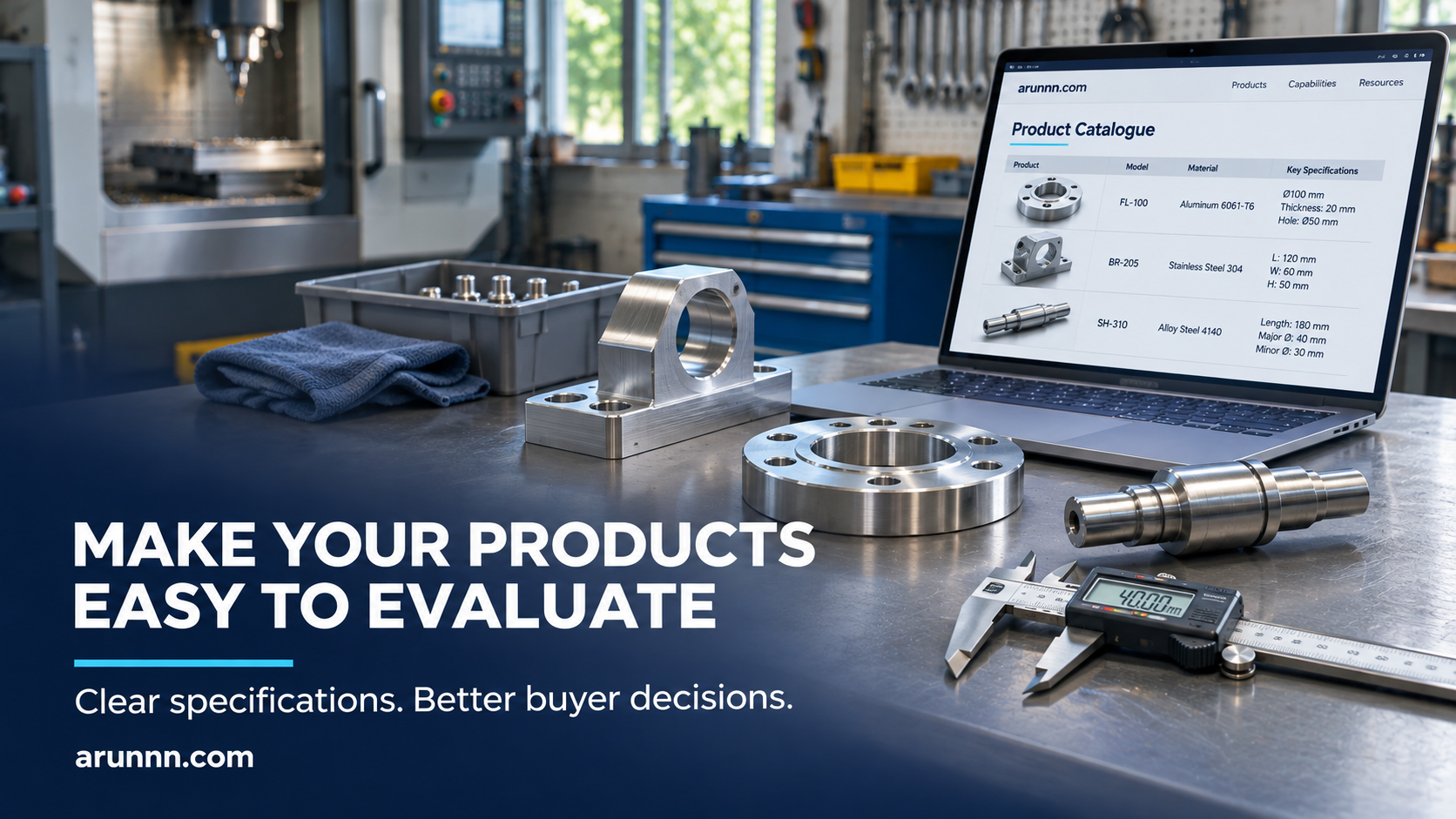
A product photograph should introduce the item. The information beside it should help the buyer decide whether to enquire. Avoid making visitors download a large brochure just to discover the basic specifications.
- Product name and reference: use the names customers recognise, alongside your model or part number.
- Specifications: list relevant materials, dimensions, grades, finishes or capacity.
- Applications: explain what the product is intended for without claiming suitability you have not verified.
- Order details: state minimum quantities or explain when they depend on customisation.
- Delivery information: describe areas served and which details affect the delivery estimate.
- Next step: place a “Request a Quote” button beside the product information.
Start with your most important product families. A smaller set of complete pages is easier to maintain than hundreds of entries with missing specifications. For a focused introductory site, explore our affordable one-page website design. Discuss a separate scope if you need individual product pages, a large catalogue or custom quotation features.
Build a quote form around the product being viewed
A visitor on a specific product page should not have to type its full name again. Where practical, carry the product name or reference into the enquiry form. Let the customer check that reference before submitting.
Keep the first step short. Request a name, business contact, product, approximate quantity and a brief requirement. Ask additional technical questions only when they help you prepare the quotation.
For custom work, you may need a drawing upload. If you include one, define accepted formats and size limits, restrict access to submissions and explain how the files will be used. A simple first enquiry followed by a secure file exchange may be sufficient for a smaller site.
After submission, show a clear confirmation and test delivery to the intended inbox. If you promise a reply time, make sure your team can meet it. Use the mobile website enquiry test to check the journey on a real phone.
Use a catalogue download as supporting material
A PDF catalogue can help a purchase team circulate information internally. However, it should support the website rather than replace the product pages.
Label downloads with their content, file size and revision date. Keep product references consistent between the catalogue and the website. If specifications change, update both versions or clearly identify which document is current.
For a small range, a clear product page and a short specification sheet may be enough. Avoid adding a compulsory registration form to every download unless you have a clear reason and a process for handling the information.
Show evidence of capability without inventing credibility
Use your own product and workshop photographs wherever possible. Show the equipment, inspection process or packaging that helps explain how you work. Add factual captions so visitors understand what they are seeing.
Publish certifications only when they are valid and relevant to the business or product described. Obtain permission before using customer logos, project photographs or testimonials. Do not fill empty spaces with unsupported client counts or delivery promises.
A useful capability section can be modest: the processes you perform, materials you handle and information needed to assess a custom job. Buyers need clear facts more than broad claims about being the best.

Choose between quotation enquiries and online checkout
Not every manufacturer needs an online shop. If prices depend on drawings, material availability, order quantity or freight, a quotation workflow may be the right starting point.
Online checkout is more suitable when the product, price and fulfilment terms can be defined clearly. Some businesses need both: checkout for standard items and a quote request for custom orders.
Decide this before building the catalogue. Explore our ecommerce website design services if your standard products need online ordering. Confirm catalogue size, payments, shipping and custom features before selecting a package.
A focused starting scope for your manufacturing website
For a manufacturer planning its first site, a practical brief could include a homepage, a capabilities page, product category pages, detailed pages for priority products and a quotation form. Add a contact page with accurate business details and the service area.
Prepare the product names, specifications, photographs and sales contact before development begins. Confirm who will update the catalogue and who will respond to enquiries after launch.
If you already have a site, first check whether its existing product pages and forms can be improved. Our one-page website redesign service is an option for a focused existing page. Ask for a tailored quotation when your manufacturing site requires multiple product pages or new integrations.
Measure quotation quality as well as enquiry volume
Ask your sales team to record whether each enquiry includes the right product, quantity and location. Note which requests lead to a quotation and which need repeated clarification.
That feedback helps you improve page content and form fields. More submissions alone do not prove that the website is producing useful business. A clearer requirement can be more valuable than several incomplete messages.
Choose the right website service for your manufacturing business
Start with the problem you need to solve. A new business may need a concise company introduction; an established supplier may need clearer product information; a seller of standard items may need online checkout. Match the service to that requirement before choosing a price.
If your existing WordPress form fails or product pages need corrections, explore WordPress fixes and edits. For workshop visits or local supply enquiries, discuss monthly local SEO services as a separate scope. Search visibility and enquiry volumes depend on competition, demand and ongoing work.
Request a manufacturing website quotation
Need a website that helps buyers understand your products and request quotations? Share your product range, current website and enquiry requirements with arunnn.
Send your product catalogue or a list of your main product families, the number of pages you need, and whether buyers should request a quote or pay online. Include your existing website address if you have one. These details help us define the website scope and prepare a quotation. A multi-page catalogue, drawing uploads and custom quotation features need a separately agreed scope; they are not implied by a one-page package.
Discuss your manufacturing website with arunnn
